
Jesse Jackson, Jr: "Those Mistakes Will Never Happen Again"
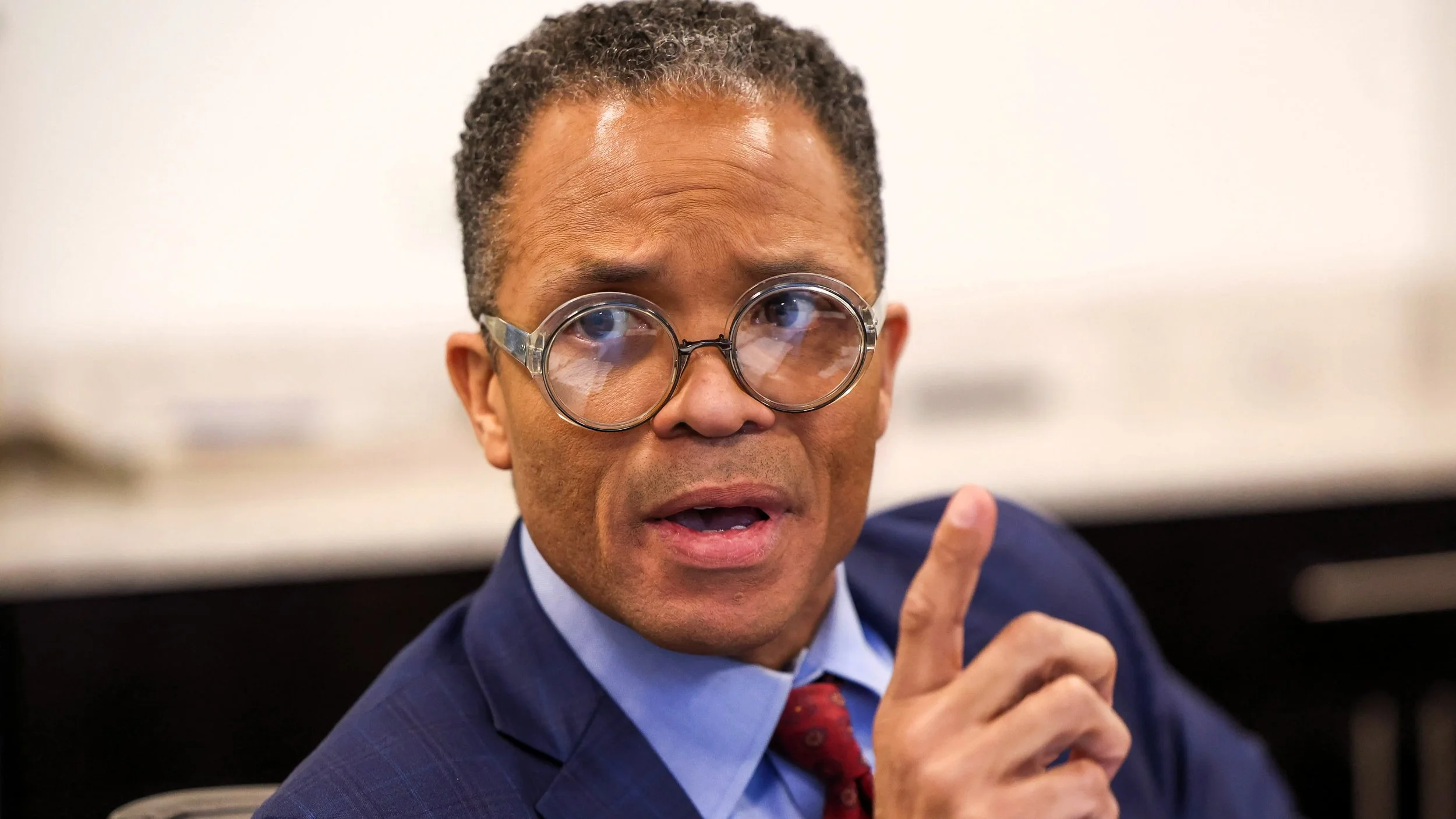
Former Congressman Jesse Jackson, Jr. speaks to a meeting of the Chicago Tribune Editorial Board in February. (Photo: Chicago Tribune)
Jesse Jackson, Jr. was political royalty on Chicago’s south side. The son of the late civil rights icon Jesse Jackson, Sr., elected to Congress at the age of 30 in 1995, it all came crashing down in 2012.
After word leaked Jackson was being investigated for financial improprieties, he resigned his seat in Congress. Less than a year later, he was convicted of wire and mail fraud, accused of misusing $750,000 in campaign funds. He served 17 months of a 30 month federal prison sentence.
Instead of a chiseled jaw and spring in his step, Jackson, now 61, has thick round glasses and more gray in his hair. He’s back in the arena, attempting to win back the seat he held for 17 years.
Jackson is locked in a battle for the 2nd Congressional District seat with top contenders including Sen. Robert Peters (D-Chicago), Sen. Willie Preston (D-Chicago), and Cook County Commissioner Donna Miller.
We spoke to Jackson Thursday in the final stretch leading to Tuesday’s election and days after the funeral services for his father, who died last month at the age of 84.
Jackson said he wasn’t considering re-entering politics until former Congressman Bobby Rush encouraged him to get into the 2nd District race after incumbent Congresswoman Robin Kelly (D-Lynwood) entered the U.S. Senate race.
Jackson’s previous 2nd District was significantly more Chicago and suburban-based, never stretching farther south than Kankakee. The current iteration of the district stretches all the way south to Danville, Rantoul, and includes heavily rural counties like Iroquois and Livingston.
“I certainly wanted to see, if given, of the red and the blue national discussion and discussion that is also taking place in our district as to whether or not I thought I could represent it. And after that exploratory effort, I made the judgment that I think I have some of the solutions for some of the existing problems,” Jackson said. “I found a commonality between people who live in the reddest part of our district with those in the northern part of the district.”
Jackson is repeating some of the refrains from his first run in Congress, including support for the long-discussed South Suburban Airport near Peotone in Will County.
“A 10,000 foot runway means nonstop access to Paris, nonstop access to Frankfurt, Germany, to Johannesburg, South Africa, to Beijing [and gives] us access to the global economy,” Jackson said. “[It means] 11,000 people will participate in the construction of that field. And after it has been completed, more than 15,000 permanent jobs. We are building a gateway in the middle of our district to the world.”
Funding to advance the airport project included in the 2019 state capital construction bill, but little movement has been made on the project in recent years.
The elephant in the room remains Jackson’s previous struggles with mental health and his criminal conviction.
“Every voter that I’ve asked to support my campaign, I was extremely transparent about it. I shared shortcomings of my ways in the past, assured them that those mistakes would never happen again,” he said. “But, because I’m human, I told them at the same time, I can’t promise that there won’t be new mistakes. I offered myself to them as a servant, and if they’d have me back, I’d be honored to represent them in Washington.”
Millions of dollars of outside spending have impacted the race. A committee tied to the America Israel Public Affairs Committee (AIPAC) has spent over $4 million in support of Donna Miller. A pro-artificial intelligence PAC has spent around $1.5 million in support of Jackson. Another $800,000 has been spent against Peters and some $400,000 has been spent in support of Peters.

